
How to Implement Firebase Push Notifications in a .NET MAUI Hybrid App
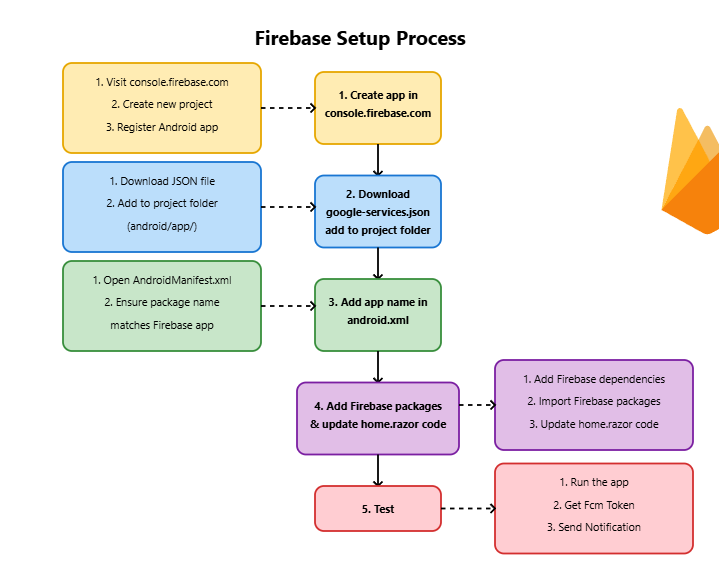
Step 1: Add Firebase Configuration Files
Add google-services.json for Android
-
Go to the Firebase Console.
-
Create a new project or select an existing one.
-
Navigate to Project Settings > General.
-
In the "Your apps" section, register your Android app.
-
Follow the instructions to download the
google-services.jsonfile. -
Place it in your project under
Platforms/Android.
Set Build Action
-
Right-click the
google-services.jsonfile in Solution Explorer. -
Choose Properties.
-
Set Build Action to
GoogleServicesJson.
Step 2: Create a .NET MAUI Hybrid Project
In Visual Studio:
-
Create a new project using the .NET MAUI Blazor App template.
-
This enables you to mix web and native mobile functionality using Razor and C#.
Step 3: Install Required NuGet Packages
Install the following packages via NuGet:
Plugin.Firebase
Plugin.Firebase.Crashlytics
Plugin.Firebase.CloudMessaging
Step 4: Handle Notification Permissions (Android)
In your AndroidManifest.xml, add the necessary permissions:
<uses-permission android:name="android.permission.INTERNET" />
<uses-permission android:name="android.permission.POST_NOTIFICATIONS" />
Step 5: Android Firebase Initialization
Create CrossFirebase Class
Inside Platforms/Android, create a file named CrossFirebase.cs:
public static class CrossFirebase
{
    public static void Initialize(
        Activity activity,
        CrossFirebaseSettings settings,
        FirebaseOptions firebaseOptions = null,
        string name = null)
    {
        if(firebaseOptions == null) {
            FirebaseApp.InitializeApp(activity);
        } else if(name == null) {
            FirebaseApp.InitializeApp(activity, firebaseOptions);
        } else {
            FirebaseApp.InitializeApp(activity, firebaseOptions, name);
        }

        if(settings.IsAnalyticsEnabled) {
            FirebaseAnalyticsImplementation.Initialize(activity);
        }
    }
}
Add Required Resources
Create a file strings.xml under Platforms/Android/Resources/values:
<?xml version="1.0" encoding="utf-8"?>
<resources>
    <string name="com.google.firebase.crashlytics.mapping_flied_id">none</string>
    <string name="com.crashlytics.android.build_id">1</string>
</resources>
Step 6: Configure MauiProgram.cs
Update MauiProgram.cs file to register Firebase services:
#if IOS
using Plugin.Firebase.Bundled.Platforms.iOS;
#elif ANDROID
using Plugin.Firebase.Bundled.Platforms.Android;
#endif

public static class MauiProgram
{
    public static MauiApp CreateMauiApp()
    {
        var builder = MauiApp.CreateBuilder();
        builder.UseMauiApp<App>()
               .RegisterFirebaseServices()
               .ConfigureFonts(fonts =>
               {
                   fonts.AddFont("OpenSans-Regular.ttf", "OpenSansRegular");
               });

        builder.Services.AddMauiBlazorWebView();

#if DEBUG
        builder.Services.AddBlazorWebViewDeveloperTools();
        builder.Logging.AddDebug();
#endif

        return builder.Build();
    }

    private static MauiAppBuilder RegisterFirebaseServices(this MauiAppBuilder builder)
    {
        builder.ConfigureLifecycleEvents(events =>
        {
#if IOS
            events.AddiOS(iOS => iOS.WillFinishLaunching((app, _) =>
            {
                CrossFirebase.Initialize(CreateCrossFirebaseSettings());
                return false;
            }));
#elif ANDROID
            events.AddAndroid(android => android.OnCreate((activity, _) =>
            {
                var settings = CreateCrossFirebaseSettings();
                CrossFirebase.Initialize(activity, settings);
            }));
#endif
        });

        builder.Services.AddSingleton(_ => CrossFirebaseAuth.Current);
        builder.Services.AddSingleton(_ => CrossFirebaseCloudMessaging.Current);
        return builder;
    }

    private static CrossFirebaseSettings CreateCrossFirebaseSettings()
    {
        return new CrossFirebaseSettings(
            isAuthEnabled: true,
            isCloudMessagingEnabled: true,
            isCrashlyticsEnabled: true
        );
    }
}
Step 7: Create Firebase Admin SDK to Send Notifications
-
Download
firebase-adminsdk.json-
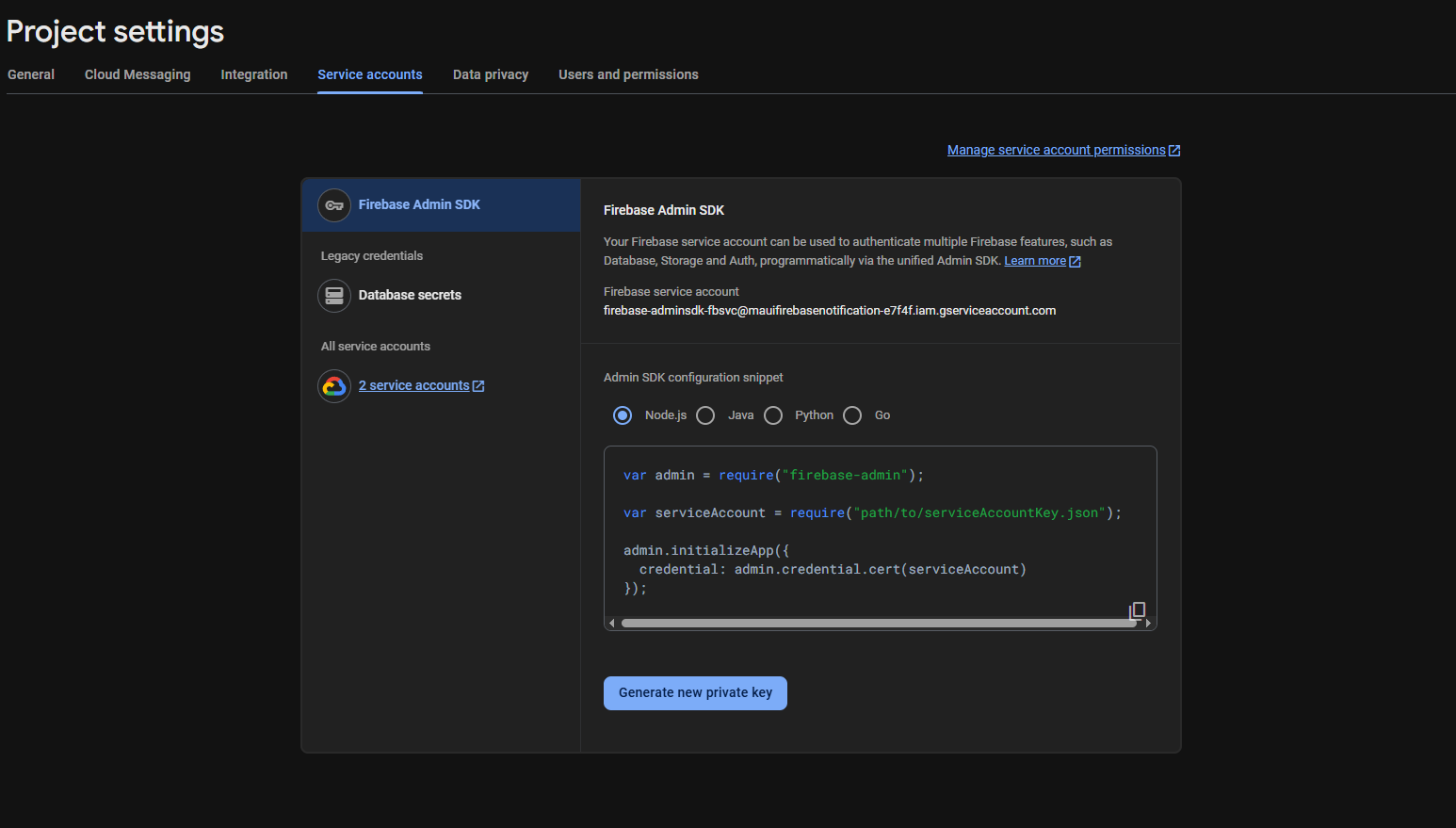
Go to Firebase Console > Project Settings > Service Accounts
-
Click Generate new private key
-
Save the file as
firebase-adminsdk.jsonin your project
-
Create PushNotification.cs
using FirebaseAdmin;
using FirebaseAdmin.Messaging;
using Google.Apis.Auth.OAuth2;
using Message = FirebaseAdmin.Messaging.Message;
using Notification = FirebaseAdmin.Messaging.Notification;

public class PushNotification
{
    private readonly FirebaseMessaging _firebaseMessaging;

    public PushNotification()
    {
        if (FirebaseApp.DefaultInstance == null)
        {
            FirebaseApp.Create(new AppOptions
            {
                Credential = GoogleCredential.FromFile("firebase-adminsdk.json")
            });
        }

        _firebaseMessaging = FirebaseMessaging.DefaultInstance;
    }

    public async Task SendPushNotification(string deviceToken, string title, string body, object data)
    {
        if (deviceTokens.Any())
        {
            var message = new Message()
            {
                Token = deviceToken,
                Notification = new Notification()
                {
                    Title = title,
                    Body = body,
                    ImageUrl = "https://media.istockphoto.com/id/472909414/photo/demo-sign-colorful-tags.jpg?s=612x612&w=0&k=20&c=JD4iYaMoe4x--zJrltwiQzZdDyvtrRuNBK0uQ80tdXg="
                },
                Data = new Dictionary<string, string>
                {
                    { "click_action", "FLUTTER_NOTIFICATION_CLICK" },
                    { "target", "counter" },
                    { "extraData", JsonConvert.SerializeObject(data) }
                }
            };

            try
            {
                var response = await _firebaseMessaging.SendAsync(message);
                Log.Information($"Push Notification sent successfully. Message ID: {response}");
            }
            catch (Exception ex)
            {
                Log.Error($"Error sending push notification: {ex.Message}");
            }
        }
    }
Register the Service
In MauiProgram.cs, register the service:
builder.Services.AddSingleton<PushNotification>();
Step 8: Sending Notification from UI (Blazor)
In Home.razor:
@page "/"
@using MauiNotificationApp.Services
@inject NavigationManager Navigation
@inject PushNotification PushNotification

<h1>Hello, world!</h1>
Welcome to your new app.

<div class="mt-4">
    @if (!string.IsNullOrEmpty(responseMessage))
    {
        <div class="@(isSuccess ? "text-success" : "text-danger")">
            @responseMessage
        </div>
    }

    @if (isLoading)
    {
        <p>Processing...</p>
    }

    <button class="btn btn-success" @onclick="SendNotification" disabled="@isLoading">Send Notification</button>
</div>

@code {
    private bool isLoading = false;
    private bool isSuccess = false;
    private string responseMessage = string.Empty;
    private string fcmToken = string.Empty;
    private string errorMessage = string.Empty;
    private string successMessage = string.Empty;

    // Get FCM token and store it in a variable
    protected override async Task OnInitializedAsync()
    {
        await CrossFirebaseCloudMessaging.Current.CheckIfValidAsync();
        fcmToken = await CrossFirebaseCloudMessaging.Current.GetTokenAsync();
        Console.WriteLine($"FCM token: {fcmToken}");
    }

    private async Task SendNotification()
    {
        if (string.IsNullOrEmpty(fcmToken))
        {
            errorMessage = "FCM token is not available. Please initialize Firebase first.";
            return;
        }

        isLoading = true;
        errorMessage = string.Empty;
        successMessage = string.Empty;

        try
        {
            var title = "Test Notification";
            var body = "This is a test notification";
            var data = new
            {
                Type = "Push Notification",
                Title = title,
                Message = body,
                Timestamp = DateTime.Now.ToString("o")
            };

            await PushNotification.SendPushNotification(fcmToken, title, body, data);
            successMessage = "Notification sent successfully!";
        }
        catch (Exception ex)
        {
            errorMessage = $"Error sending notification: {ex.Message}";
            Console.WriteLine($"Notification Error: {ex}");
        }
        finally
        {
            isLoading = false;
            StateHasChanged();
        }
    }
}
You've now successfully integrated Firebase Push Notifications into your .NET MAUI Hybrid App!
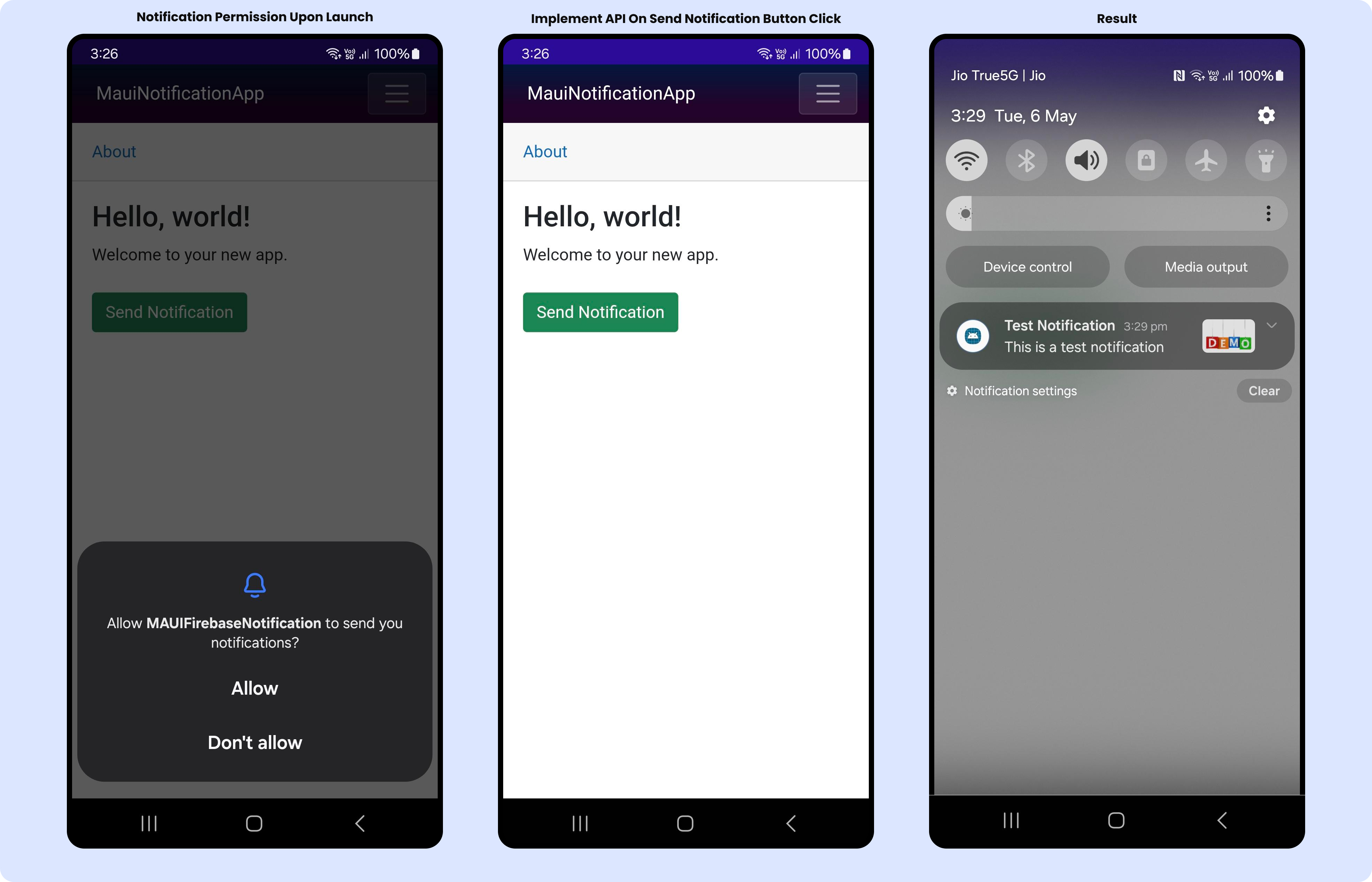
Diagram:


Ghanshyam Digital
33 posts published
A Software Company delivering Softwares, Web Applications, Mobile Applications using latest technologies.
Subscribe to the newsletter
Get new posts delivered to your inbox.
More from this blog



 Let's talk about your project!